Colleges Are Discounting Like Car Dealers. Families Notice.
When the price of a college degree starts behaving like the price of a used car, families stop trusting the seller. Right now, that’s exactly what’s happening.
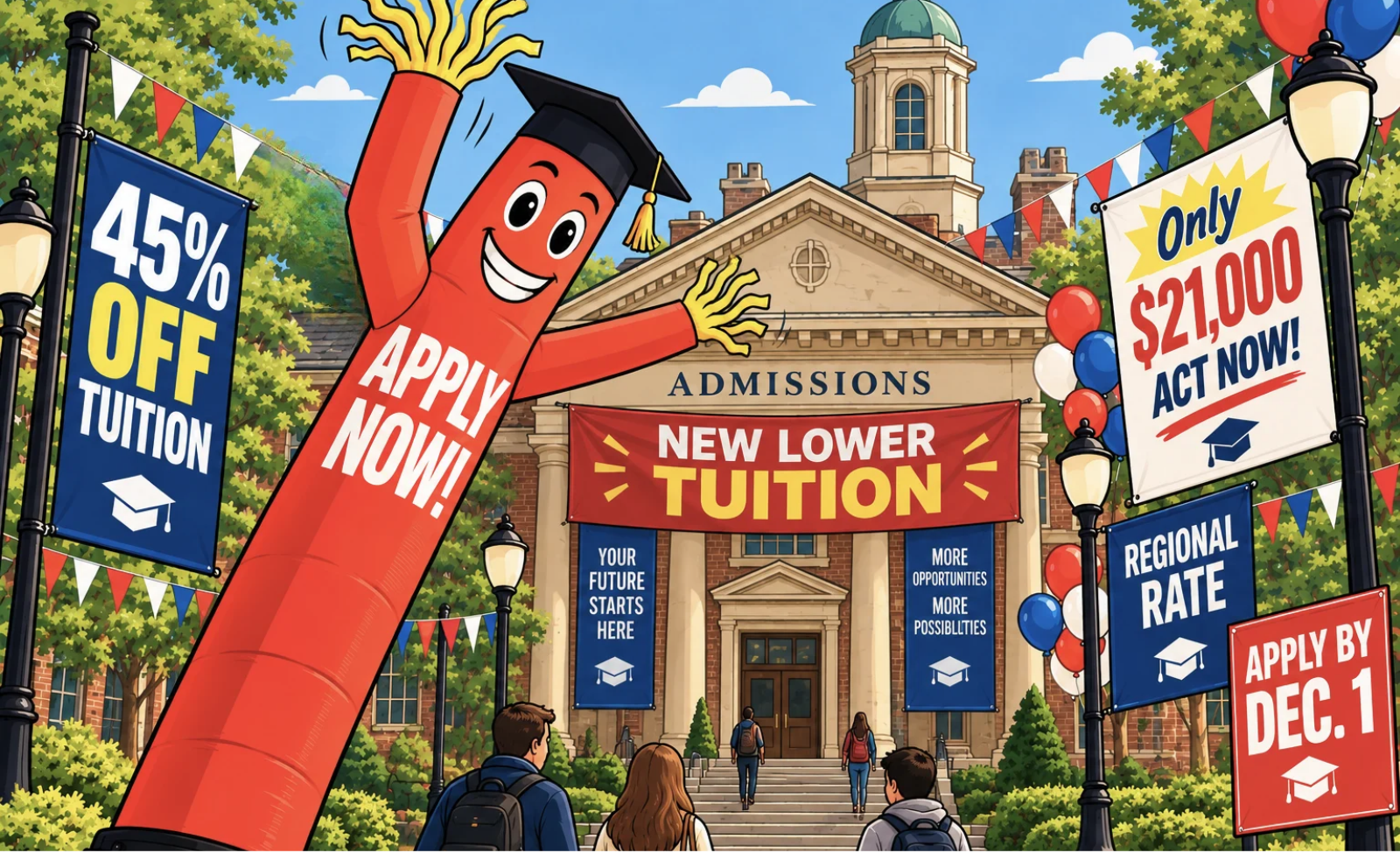
The Lot is Full of Balloons.
I’ve been noticing a growing trend over the past several months, and started keeping tabs on college pricing announcements. I felt like I was clipping coupons from the paper when I realized what I was seeing wasn’t a financial-aid strategy, it was a used car lot. Sticker prices nobody is expected to pay, “act now” deadlines, and “special rates” for people who just happen to live in the “right” area. Big headline percentages engineered to make families feel like they’re getting a steal. Balloons on the light poles, a banner over the entrance, and an actual price that just happens to be whatever they think you’ll pay.
This is the elephant in the room and the real reason public faith in higher education is falling like a ship from heaven. If we run the most important investment of a young person’s life like a Saturday clearance event we really shouldn’t be surprised when people start to wonder what else we’re not being straight about.
I received an email from the Chronicle for Higher Education rounding up how colleges are jostling on price as the pool of high-school graduates shrinks, and honestly, it feels like I’m walking through the parking lot. One college in middle America is resetting its tuition sticker price down 45%. Another further north is cutting 20% down to $21,700 more than a decade after doing the exact same thing and crediting the move for enrollment growth. A college on the East Coast will hand “virtually any” accepted in-state student a $30,000 annual package as long as they apply by December 1. Seriously? That’s not financial aid. That’s a “this weekend only” discount.
As Bloomberg’s Allison Schrager put it, college is “less like an overvalued stock about to crash than an expensive bond due for a repricing.” A no-loan pledge signals money. A tuition reset or regional discount signals a market where leaders see weakness. Holy Cross’s president, Vincent Rougeau, said families “look at cohorts of schools,” And when one institution in that cohort moves on cost it trickles down and pulls along everyone who believes they belong in that group. In other words, most of these discounts aren’t advertising parent opportunities as a buyer. They’re signaling seller anxiety.
But here’s the thing none of these schemes accomplish. None of this price theater and discount marketing builds trust, and none of it builds the next entering class.
Because price was never the currency that mattered in higher ed admissions. It’s the relationships that are the only currency in this business with any real value. A discount is a one-time transaction; a relationship is a living pipeline. You can shave 45% off of MSRP and still lose the kid to the school that knew her name three years in advance of application. Don’t believe me? Ask Syracuse. Families don’t fall in love with coupons. They fall in love with a place where they can see their kid, early and specifically, before there’s anything to sign.
We actually have proof of what the other model looks like. Programs like SIUE’s, and the growing number of institutions building real K-12 pipelines, are seeing genuine growth. Growth fueled not by being the cheapest, but by starting the relationship years before the deadline. The colleges talking to students in middle school have the advantage. If you don’t know their name by the time they’re fifteen, you’re already behind the ball. By the time a 45%-off email lands in a high-school senior’s inbox, the school that did the relationship work has already won. The email is just noise on top of a decision that was quietly made a long time ago.
There’s one corner of campus that has been doing this for generations: athletics. Coaches have always been able to identify talent early, build the relationship with the family, and know the kid’s dog’s name long before signing day. Nobody wins athletics recruits with last-minute price cuts. Athletes get something a discount can’t buy - the trust of a family that wants their child to succeed. You don’t find that in the clearance section.
So here’s the ask for every president, provost, and enrollment leader staring down the barrel of a demographic cliff: stop competing on the sticker price and start competing on the depth of your relationships. The reset, the ZIP code deal, and the “first in the door” scholarship - those are the moves you make when you’ve run out of relationships to spend. You need to decide which business you’re actually in: the balloons-on-the-lot business, or the knowing-the-student business.
The cliff won’t be survived by whoever discounts the fastest. It’ll be survived by those who know the students first and best. Everyone else is just rearranging the banners.