
Why the Smartest Enrollment Strategy Isn’t Chasing Population Growth
Enrollment leaders face a clear choice as they confront the K–12 demographic cliff: continue chasing raw population headcount, or target established talent infrastructure.
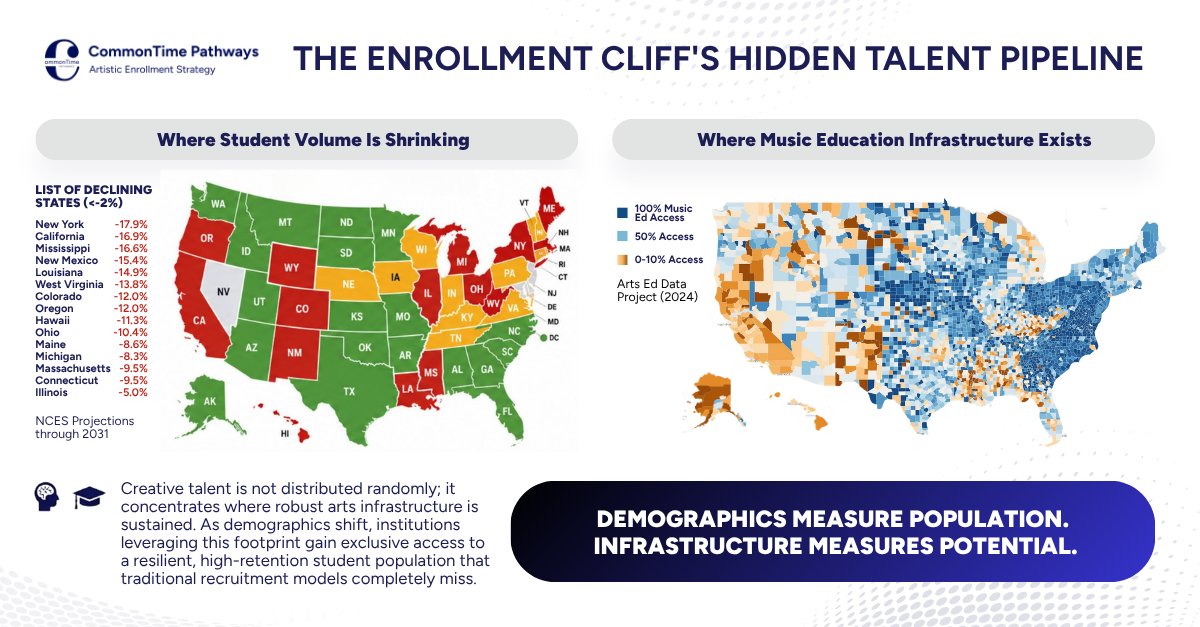
The traditional playbook relies heavily on a single metric: population density. This model prompts institutions to reallocate recruitment budgets away from contracting states like New York (-17.9%) or Ohio (-10.4%) to compete for market share in high-growth regions.
However, overlaying NCES demographic projections with the National Music Education Access Map exposes an alternate, highly strategic route.
This map—compiled by the Arts Education Data Project and shared by Bob Morrison—measures access by county based on the percentage of public schools offering music education. It reveals that many regions facing steep student population declines still maintain incredibly stable school music infrastructures. In these specific markets, the institutional pipeline is already built and fully operational.
For a VP of Enrollment, this isn't an artistic metric. It is a baseline operational indicator.
You do not need a campus full of music majors; you need a campus full of students who graduate. Students who participate in school music programs develop a distinct profile marked by systematic collaboration, accountability, and resilience: Artistic Intelligence. This specific behavioral profile correlates directly with the exact traits that drive higher college persistence and retention rates, regardless of a student's chosen major.
When top-of-funnel student volume drops, net tuition revenue depends entirely on enrolling cohorts that persist. The high-engagement talent pool in these markets has not vanished; it has simply concentrated inside active school music programs.
Yet, traditional search models leave this creative data completely unmapped. While higher education spends millions on data pipelines to scout athletes, exceptional non-major instrumentalists and vocalists heading into engineering, business, or nursing remain invisible to traditional recruiting systems as creatives.
CommonTime Pathways bridges this exact structural gap.
Navigating the next decade of enrollment shifts is a data-scouting game, not a volume chase. The institutions that survive the cliff will stop blindly chasing moving populations and start leveraging the built-in school pipelines that produce resilient, high-retention students every day.
Want to see how your institution can map and tap into this unreached talent pool? 👉 Let’s look at your regional data together. Visit ew.ctpathways.com to schedule a strategy session.
Sources:
National Center for Education Statistics (NCES)
Arts Education Data Project (AEDP)
